
Industrial Centrifuge Buyer Guide
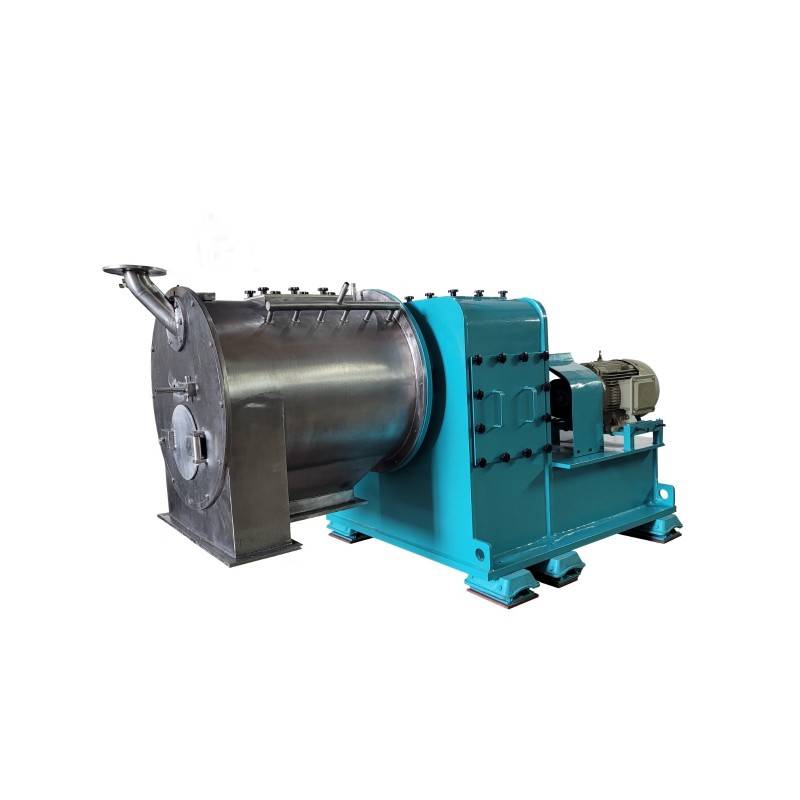
Pusher Centrifuge Selection for Salt Crystallization
Salt name and hourly demand do not establish pusher centrifuge fit. The buyer must define crystal behaviour, mother liquor, feed variability, wash duty, materials and acceptance methods.
Direct answer
A pusher route is credible when representative salt crystals retain on a screen, form a stable free-draining cake, tolerate continuous axial transport and meet the required wash and particle-integrity limits. Confirm those behaviours over the feed envelope before source matching. Keep screen scroll or batch filtration open when the evidence or process priority points elsewhere.
What defines the salt duty?
Name the salt and crystal or hydrate form where relevant, crystallization route, temperature history, mother-liquor composition, impurities, recycle and downstream handling. A sample should represent both normal and difficult production.
Record whether the commercial basis is slurry flow, wet solids or dry solids. Supplier proposals cannot be compared when the capacity basis differs.
When is a pusher centrifuge suitable?
| Question | Evidence supporting review | Escalation trigger |
|---|---|---|
| Will particles retain? | Representative PSD, screen trial and fines-loss observation | Fines variation or screen bypass is material |
| Will a cake form and drain? | Cake formation, permeability and liquor-release observations | Sticky, compressible or blinding behaviour |
| Can the cake be transported? | Representative transport or pilot evidence | Smearing, blockage or unacceptable crystal damage |
| Can washing be defined? | Wash liquid, sequence, ratio, purity method and recovery route | A generic “wash required” statement |
| Is continuous operation stable? | Minimum, normal and maximum feed with upset response | Only one ideal feed point is tested |
What belongs in the material test?
- Traceable sample identity and conditioning
- Feed solids, PSD, crystal shape and mother-liquor properties
- Screen and test configuration
- Feed, drainage, cake, wash and discharge observations
- Before/after particle comparison where breakage matters
- Cake, liquid, recovery and purity results using proposed contract methods
- Scale-up limitations and unresolved data
How should washing be specified?
State wash liquid, temperature, addition point, sequence, ratio or quantity basis, impurity target, analytical method and where recovered liquid goes. Washing performance cannot be separated from cake uniformity and drainage.
A supplier alternative should show its effect on purity, recovery, liquid handling, cycle or residence and utilities.
How should crystal breakage be controlled?
Define why particle integrity matters downstream, then agree a representative sampling and particle method before and after separation. Include transfer, pumping and sampling effects so the centrifuge is not assigned damage caused elsewhere.
What should the guarantee say?
| Result | Boundary |
|---|---|
| Throughput | Dry-solids or slurry basis, composition, feed range and stable period |
| Cake moisture | Sampling, conditioning, analytical method and averaging |
| Recovery | Mass-balance boundary and analysis method |
| Purity / washing | Feed impurity, wash basis, sampling and method |
| Breakage | Before/after particle method and allowable change |
A practical buyer decision path
Define
Application, specification, quantity, destination and evidence needs.
Compare
Align supplier responses, methods, exclusions and commercial basis.
Verify
Check the agreed company, product, document or on-site scope.
Control
Record samples, approvals, changes, inspection and shipment milestones.
Close
Deliver the agreed record, open-item list and next-step decision.
Why it matters
A copied model or catalogue result can hide a different crystal distribution, liquor, capacity basis or test method. Align the process evidence before aligning price.
Buyer decision criteria
- Representative screen retention and cake drainage
- Stable continuous cake transport
- Acceptable fines loss and crystal change
- Defined wash and liquid recovery route
- Component-level materials review
- Testable performance and interface boundaries
Specification checklist
| Group | Required input |
|---|---|
| Material | Salt identity, form, PSD, shape, fragility and sample history |
| Liquor | Composition, density, viscosity, pH and temperature |
| Feed | Minimum, normal and maximum flow and solids |
| Results | Cake, recovery, liquid quality, purity and breakage with methods |
| Site | Materials, hazards, utilities, controls and destination documents |
Document checklist
- Controlled process and equipment data sheet with revision status
- Supplier technical offer and line-by-line deviation register
- General arrangement, interfaces, foundation information and utility list
- Wetted-material schedule and buyer-requested source evidence
- Motor, drive, instrument, interlock and control-system documents
- Inspection and test plan with hold or witness points
- Material-test, FAT and SAT protocols and records where included
- Operation, safety, cleaning and maintenance manuals in the agreed language
- Spare-parts, wear-parts, packing, preservation and shipment-document list
Common mistakes
- Selecting from hourly capacity alone
- Using average particle size without the fines tail
- Comparing offers with different dry-solids and slurry bases
- Writing a cake target without a method
- Adding washing after design freeze
- Treating a no-load FAT as process proof
Questions to ask suppliers
- Which submitted process inputs and representative tests support the proposed principle?
- Which assumptions, exclusions and open technical items remain?
- How are throughput, cake, recovery, liquid quality and wash results measured?
- Which wetted material applies to each component, and what evidence is available?
- What is demonstrated during material test, FAT and SAT respectively?
- Which drawings, manuals, inspection records, spares and commissioning services are included?
- Which buyer-requested conformity documents are available for this exact source and scope?
Related products and pages
Technical RFQ
Submit process, result, site and document inputs.
Frequently asked questions
Is every salt slurry suitable for a pusher centrifuge?
No. Screen retention, drainage, cake transport, washing and breakage must be evaluated.
What PSD should be supplied?
Provide the representative distribution, fines tail, shape, agglomeration and expected variability with the method.
Can cake moisture be copied from a brochure?
No. It needs a feed envelope, sampling point, method and supplier commitment.
Should screen scroll remain an option?
Yes when the same evidence supports screen filtration and scroll transport better than the pusher route.
What if representative material is unavailable?
Record the gap, assumptions and later validation gate instead of presenting an estimate as proven performance.
Where should the data be submitted?
Use the centrifuge technical RFQ and attach available particle, process and safety files.
Sources & references
GB 19815-2021, Centrifuge—Safety requirements, National Public Service Platform for Standards, published 2021-04-30, effective 2022-05-01, accessed 2026-09-07.
GB/T 10895-2025, Centrifuge & separator—Measurement and evaluation of mechanical vibration, National Public Service Platform for Standards, published 2025-08-01, effective 2026-02-01, accessed 2026-09-07.
Standards titles are cited for review context. A source-specific declaration, certificate or test record must still be checked for model, scope, revision, validity and project applicability.
Send us your sourcing requirement
Share the specification, quantity, destination and required documents. We will review the request before matching a suitable supply source.
Review and evidence note
Last reviewed: 2026-09-07
This guide provides non-numeric buyer controls. It does not confirm a supplier, machine size, material compatibility, certification or performance guarantee.
Final product availability, specification, documentation and commercial terms are confirmed during supplier matching and quotation.