
Centrifuge Application Guide
Centrifuge Selection for Ammonium Sulfate Crystals
Prepare an ammonium sulfate centrifuge request from actual crystal and mother-liquor data, not from a copied machine model or universal cake result.
Direct answer
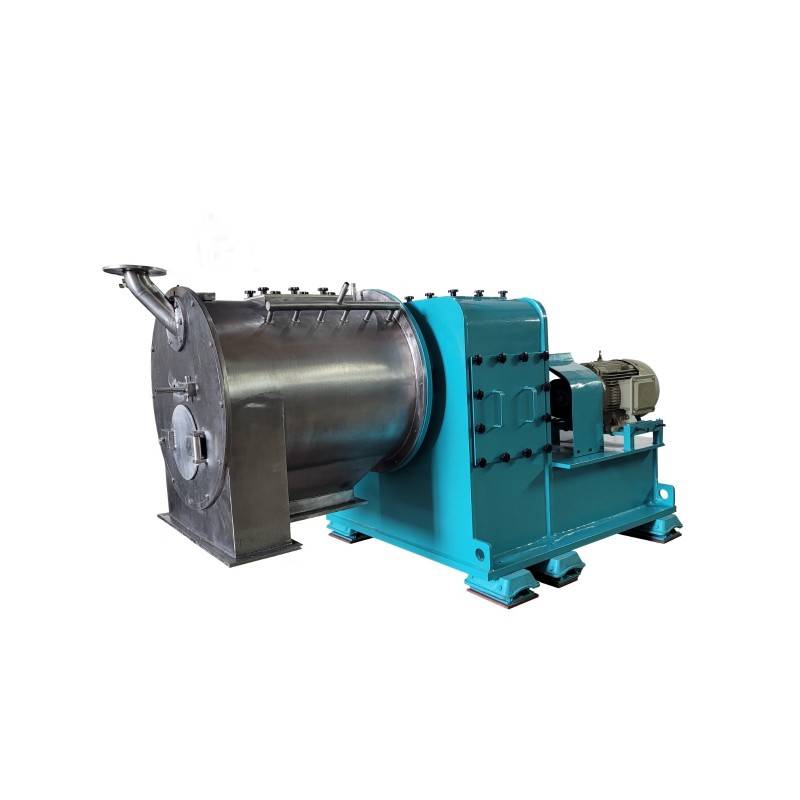
Ammonium sulfate crystals may enter pusher, screen scroll or batch-filtering reviews when screen retention and cake behaviour are credible. The decision changes with the crystallization route, fines load, mother liquor, feed variability, wash target and allowable breakage. Confirm the actual feed through representative data and testing before a supplier commits to equipment or performance.
What material and process boundary must be identified?
Identify the production route, crystal form and distribution, mother-liquor composition, impurities, recycle, temperature and whether the sample represents normal and difficult operation.
Do not transfer a result from another grade, plant or supplier without checking that feed preparation, liquid phase, particle behaviour and measurement method match.
What feed data change the decision?
| Variable | Buyer input | Selection effect |
|---|---|---|
| PSD and shape | Distribution, fines, agglomerates and fragility | Screen, cake, transport and breakage |
| Liquor | Composition, density, viscosity and temperature | Drainage, washing and materials |
| Feed range | Flow and solids at minimum, normal and maximum | Machine operating envelope |
| Product target | Moisture, purity, recovery and allowable particle change with methods | Guarantee and test basis |
Which centrifuge principles should be screened?
The rows below are routing questions, not universal recommendations. A qualified review can keep more than one principle open until representative behaviour and project priorities are understood.
| Principle | Review when | Do not assume |
|---|---|---|
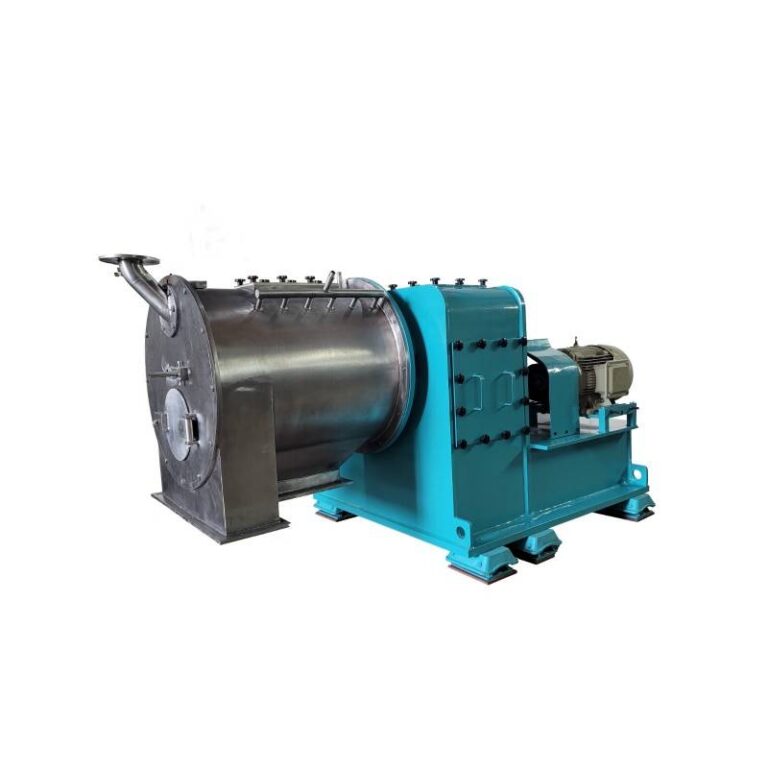
| Pusher | Stable, free-draining screen-retained cake supports continuous transport. | Do not universalize a result from another plant. |
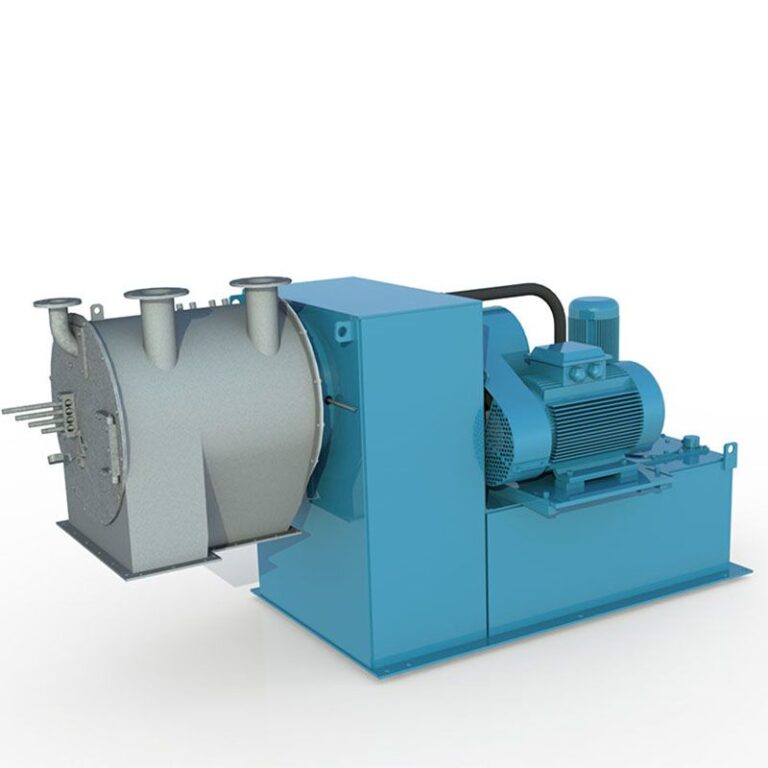
| Screen scroll | Continuous screen filtration and scroll transport are demonstrated. | Do not omit screen wear and fines loss. |
| Peeler / basket | Batch washing, segregation or discharge control is important. | Do not compare spin time as total cycle. |
| Decanter | Fine suspended solids make settling more relevant. | Do not assume it produces the same crystal product. |
When is a pusher route credible?
Review pusher fit using the full fines tail, liquor viscosity, cake permeability, required wash and particle-change evidence across the production range.
Screen retention, stable cake formation, continuous transport and acceptable breakage should be demonstrated. A familiar chemical name does not establish those conditions.
When is a decanter route credible?
Keep decanter screening limited to the actual fine-solids or suspension duty and confirm whether the discharged product and liquid result match downstream needs.
Settling response, density difference, rheology, centrate target and screw transport should be reviewed together. Fine solids alone do not guarantee a successful decanter duty.
What should a representative material test record?
- Sample identity, production source, collection date, storage and conditioning
- Feed composition, solids, temperature, particle or settling observations and variability
- Test apparatus, operating sequence, settings and any conditioning aid
- Compare representative normal and fine-rich samples.
- Measure product and liquid results using methods intended for the contract.
- Mass-balance boundary, sample locations, analytical methods, raw results and observations
- Limits of scale-up and open questions for engineering review
How should required results be written?
| Result | Required boundary |
|---|---|
| Cake moisture or dry solids | Sampling point, method, feed envelope, stable-operation period and averaging |
| Solids recovery | Mass-balance boundary, sampling period and analysis method |
| Filtrate or centrate quality | Sampling location, solids method and conditioning basis |
| Purity or wash result | Wash liquid, sequence, ratio and product analysis method |
| Allowable breakage | Before/after sampling and agreed particle method |
| Throughput | Solids or slurry basis, composition, temperature and operating range |
Which materials and corrosion inputs are required?
Provide mother-liquor composition, temperature, cleaning chemicals and corrosion history. Request component-level materials and source evidence.
Preferred wetted material is a buyer input, not proof of compatibility. Ask the selected source to identify exact component scope, material evidence, fabrication limits, cleaning exposure and exclusions.
What safety and containment questions must be closed?
Identify chemical exposure, dust, temperature, cleaning and any classified-area requirement from the project hazard review.
If flammable solvent or combustible hazard is present, provide solvent identity, flash point, vapor data, area classification, inerting requirement and the buyer-requested standard. XiangtanExport does not state that a source is ATEX or IECEx compliant without scoped evidence.
What process interfaces belong in the RFQ?
- Upstream vessel, crystallizer, reactor, thickener, pump or conditioning step
- Minimum, normal and maximum feed and credible upset conditions
- Downstream solids handling, dryer, dissolution, product recovery or disposal
- Liquid recovery, recycle, treatment or solvent-recovery route
- Control signals, interlocks, utilities, layout, lifting and maintenance access
- Responsibility for piping, cabling, foundation, installation and commissioning
Which supplier questions prevent scope gaps?
- Which submitted feed data and test evidence support the proposed principle?
- What assumptions, exclusions and missing variables remain?
- Which wetted materials apply to each component and what evidence is offered?
- How are cake, recovery, liquid quality, washing and throughput results measured?
- Which process results can be demonstrated at material-test, FAT and SAT stages?
- What drawings, manuals, certificates, spares and commissioning inputs are included?
- Which deviations from the controlled RFQ require buyer approval?
How should material test, FAT and SAT be separated?
Material testing examines separation behaviour. FAT verifies the agreed factory mechanical, control, safety and document scope. SAT verifies site integration and, when contracted, project performance under a stated feed and utility basis. Do not use a no-load FAT as evidence of cake moisture, recovery or throughput.
Which documents should be in the contract?
- Approved process and equipment data sheet
- General arrangement, interface and foundation information
- Wetted-material schedule and requested source evidence
- Motor, controls, instruments, interlocks and utility list
- Inspection and test plan, FAT/SAT protocols and records where included
- Operation, safety, cleaning and maintenance manuals
- Wear and spare-parts list
- Packing, preservation, lifting and shipment documents
- Buyer-required conformity evidence: availability subject to source confirmation
What should the technical RFQ include?
Send crystal distribution, liquor composition, feed range, wash plan, product and filtrate targets, corrosion information and available lab or pilot records.
Unknown values may be marked unknown. Keeping an explicit gap is safer than inserting a catalogue assumption that later becomes a contract conflict.
Submit the centrifuge technical RFQ
Preserve process, result, site, document and attachment inputs in one inquiry.
Related principles and buyer guides
Commercial sourcing and export support
Sources & references
GB 19815-2021, Centrifuge—Safety requirements, National Public Service Platform for Standards, published 2021-04-30, effective 2022-05-01, accessed 2026-09-07.
GB/T 10895-2025, Centrifuge & separator—Measurement and evaluation of mechanical vibration, National Public Service Platform for Standards, published 2025-08-01, effective 2026-02-01, accessed 2026-09-07.
Public sources establish standards context only. Supplier identity, model, performance, materials, certification evidence and commercial terms remain private and source-specific.
Frequently asked questions
Does this page select a machine for every ammonium sulfate crystal separation project?
No. It identifies data and tests needed for a project-specific engineering review.
Can two plants using the same material need different principles?
Yes. Feed preparation, particle behaviour, liquid properties, variability, washing and required results can differ.
Can a supplier catalogue value be used as a guarantee?
Not without an agreed feed envelope, measurement method, conditions and source commitment.
Are ATEX, IECEx or CE included automatically?
No. Required standards are buyer inputs; source-specific availability, scope and evidence require confirmation.
When is a material test useful?
When feed behaviour or scale-up assumptions materially affect principle, design or performance risk.
Does XiangtanExport reveal the supplier pool?
No. Candidate sources and scorecards stay private unless disclosure is approved for the transaction.
Send process data for technical review
Provide the material, feed envelope, separation target, utilities, site and document requirements. We will identify missing data before private supplier matching.
Review and evidence note
Last reviewed: 2026-09-07
This application page provides non-numeric selection logic. It does not confirm a supplier, machine size, performance guarantee, material compatibility or certification.
Final product availability, specification, documentation and commercial terms are confirmed during supplier matching and quotation.